

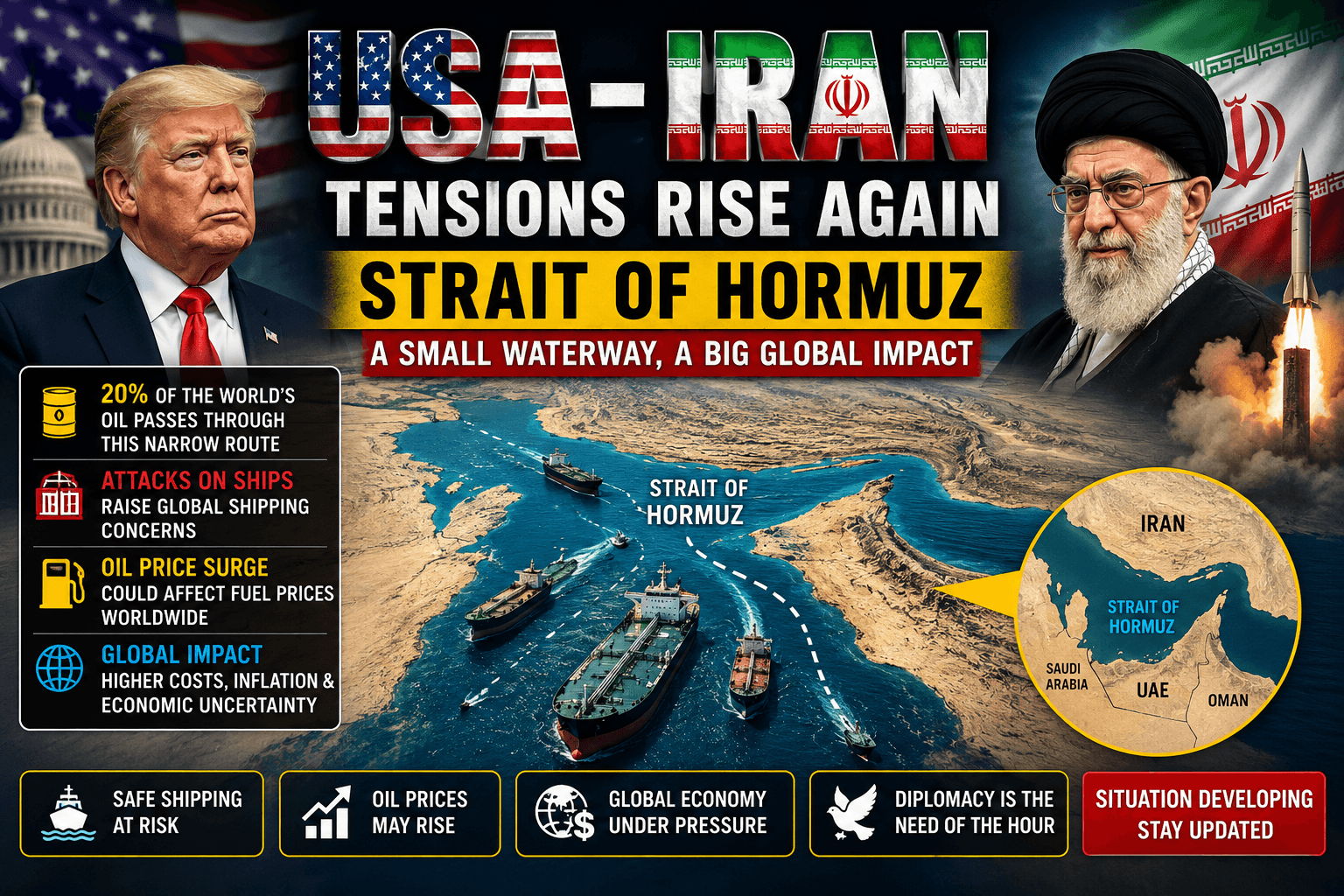
USA Iran tensions are rising again, putting the Strait of Hormuz at the centre of global attention.
The tension between the United States and Iran has once again become a major international story. This time, the focus is on the Strait of Hormuz, a narrow but extremely important waterway in the Middle East.
For many people, the Strait of Hormuz may sound like a distant geographical location. But what happens there can affect countries around the world, including India.
The latest statements from the United States and Iran have increased concerns about shipping, oil supplies and the global economy.
What is happening between the USA and Iran?
U.S. President Donald Trump has made a strong statement regarding the Strait of Hormuz. He said the United States could potentially declare the strategically important waterway a U.S. territory after what he described as the defeat of Iran.
Iran has strongly rejected this position. Iranian officials have said that the Strait of Hormuz remains under Iranian control and that the country will not accept claims of U.S. ownership over the waterway.
The statements from both sides have added another layer to an already tense situation.
At the moment, the biggest concern is not only the political disagreement. The real concern is what could happen if the situation affects commercial ships and the movement of oil through the region.
Why is the Strait of Hormuz so important?
The Strait of Hormuz connects the Persian Gulf with the Gulf of Oman and the Arabian Sea.
It is one of the most important routes for the transportation of oil and other energy products. A large amount of the world’s oil supply has traditionally passed through this narrow waterway.
That is why even a temporary disruption can create nervousness in international markets.
If ships are unable to move normally through the Strait, oil companies and governments may start worrying about future supplies. This can push oil prices higher and increase uncertainty in financial markets.
In simple terms, a problem in one narrow waterway can create a much bigger problem for the global economy.
Could this affect petrol and diesel prices?
This is probably the question most people are asking.
If the supply of crude oil is affected for a long period, international oil prices could rise. Higher crude prices can increase the cost of transportation and put pressure on businesses.
However, this does not mean petrol and diesel prices will automatically increase immediately in every country.
Fuel prices depend on several factors, including international crude prices, currency exchange rates, government policies and domestic pricing decisions.
Still, a prolonged crisis in the Strait of Hormuz would be something that oil-importing countries would need to watch carefully.
What about international shipping?
Oil is not the only concern.
The Strait of Hormuz is also important for commercial shipping. If companies believe that ships are at risk, they may delay journeys or look for alternative routes.
Alternative routes can take longer and may require more fuel. That means transportation costs can increase.
If the situation continues for weeks or months, those additional costs could eventually be felt by businesses and consumers.
Recent attacks involving commercial vessels in the region have already increased concerns about the safety of ships travelling through the area.
Why should India be concerned?
India is closely connected to the global energy market.
The country imports a significant amount of crude oil, which means international oil prices are important for the Indian economy.
If crude oil prices rise sharply, the impact can be seen across several sectors. Transportation, logistics, manufacturing and agriculture can all be affected by higher energy costs.
For ordinary people, the impact may not appear immediately. But if higher fuel and transportation costs continue for a long period, they can increase the cost of moving goods and may eventually affect household expenses.
That is why developments in the Middle East are important even for people living thousands of kilometres away from the Strait of Hormuz.
What is Iran saying?
Iran has strongly rejected the U.S. position on the Strait.
Iranian officials have said that the waterway remains under Iranian control and that the country will not simply accept Washington’s claims.
Tehran’s position is that decisions concerning the Strait are closely connected to Iran’s sovereignty and national security.
The strong response from Iran shows that the issue is unlikely to disappear quickly.
What is the United States saying?
The United States continues to put pressure on Iran as part of the wider confrontation between the two countries.
Washington has said that its actions are linked to its concerns about Iran’s nuclear programme and regional security.
President Trump has also warned Americans that the ongoing conflict could result in higher fuel costs.
His latest comments regarding the Strait of Hormuz have attracted international attention because of the strategic importance of the waterway.
Is there a chance for negotiations?
Despite the growing tension, diplomacy remains an important possibility.
Regional countries have an interest in preventing the situation from turning into a much larger conflict. Any agreement that allows commercial shipping to return to normal could help reduce pressure on oil markets.
However, the United States and Iran currently have very different positions on several major issues.
That makes the road to a quick agreement difficult.
What could happen next?
The coming days will be important.
The world will be watching whether commercial shipping through the Strait of Hormuz returns to normal, whether the United States and Iran restart meaningful negotiations and whether tensions increase further.
If both sides move towards diplomacy, the situation could gradually stabilize.
But if military tensions increase and shipping continues to be disrupted, the consequences could become much wider.
Oil prices, shipping costs and financial markets could all face additional pressure.
The bigger picture
The Strait of Hormuz may be geographically small, but its importance is enormous.
The current USA–Iran dispute shows how a regional conflict can quickly become a global economic issue.
For India and other countries that depend heavily on imported energy, the situation deserves close attention.
At this stage, it is too early to say exactly how the crisis will develop. The situation is changing rapidly, and new decisions from Washington or Tehran could change the picture within hours.
For readers, the most important thing is to follow reliable information rather than rumours circulating on social media.
We will continue to watch the developments and bring you important updates as the situation changes.
What do you think?
Do you think the Strait of Hormuz crisis could affect India, fuel prices and the cost of everyday goods?
Share your opinion in the comments below.
For more international news, government updates and important developments, follow Mazi Seva.